

Maintaining a clean and hygienic domestic bathroom requires more than standard household surface cleaners. Because bathrooms are characterised by high humidity, elevated temperatures, and frequent water contact, they represent ideal breeding grounds for opportunistic fungi. Over time, these microscopic organisms colonise tile grout, silicone sealants, and painted walls, creating dark, unsightly stains that are highly resistant to standard physical scrubbing. This systematic, criteria-based evaluation reviews the leading bathroom mould and mildew sprays on the United Kingdom market, comparing their chemical formulations, physical delivery formats, safety profiles, and surface compatibility guidelines.
Finding an effective mould treatment requires looking past marketing claims to analyse the core chemistry disclosed in regulatory documents. Most commercial products rely on active chlorine compounds to oxidise fungal cells, but their real-world behaviour is heavily influenced by their delivery format and contact time on vertical surfaces. This review is a document-led analysis based on publicly available Safety Data Sheets (SDS), manufacturer-published specifications, and product labels. To bridge the gap between chemical parameters and domestic application, we have synthesised these specifications with consolidated consumer feedback from UK homeowners. This approach highlights critical user friction points, including stiff safety triggers, intense chlorine odours, and the risk of damaging sensitive bathroom fixtures, allowing buyers to make an informed choice.

- HG Mould Remover: Effortlessly eliminates all moulds, making filthy black stains disappear in under 30 minutes, whilst preventing re-growth
- Suitable for a wide range of surfaces: Removes mould & fungus from plastered walls, tiles, bathroom seals, grout, windows, outdoor furniture & more
- For indoor or outdoor use: Kills algae & mould marks around swimming pools, in the garage, shed, washing area, shower cubicle, sauna & conservatory
- Fast acting: This rapid use mould & mildew remover immediately cleans fungus marks from damp areas. The foam remains on the surface for longer & reduces splashing
- 500ml size HG Mould Foam Spray: Anti mould cleaner with a bleaching effect. Low odour formula. Test first in an inconspicuous place before applying

Surface compatibility remains a critical factor when choosing a treatment. High-concentration chemical sprays can degrade silicone sealants, dissolve tile grout, and tarnish delicate metal fixtures like chrome taps or anodised shower frames if not managed precisely. This evaluation establishes clear, evidence-led ratings to help buyers select a mould spray that aligns with their specific bathroom materials, ventilation capacity, and safety requirements.
Evidence Status and Document Sources
Methodological transparency: This review is an evidence-led, document-based analysis rather than a hands-on laboratory evaluation. Findings are synthesised from official Safety Data Sheets (SDS), manufacturer-published usage instructions, product labels, and verified consumer feedback where source-audited. We do not currently hold Technical Data Sheets (TDS) for these products. Chemical concentrations and hazard classifications are therefore based strictly on the disclosures provided in the SDS documentation listed below.
| Product Name | Document Source | Document Date / Version | Disclosed Active Ingredient | Disclosed pH |
|---|---|---|---|---|
| HG Mould Remover Foam Spray | Wickes COSHH SDS (HG Hagesan) | 03/04/2024 (Version 1.0) | Sodium hypochlorite (2-5%) | 13.3 |
| HG Mould Spray | Wickes COSHH SDS (HG Hagesan) | 27/03/2024 (Version 1.0) | Sodium hypochlorite (2-5%) | >13.0 |
| Astonish Mould & Mildew Blaster | London Oil Refining Company SDS | 21/09/2021 (Version 10.1) | Sodium hypochlorite (1-5%) | 12.0-13.7 |
| Cillit Bang Mould & Mildew Remover | Janitorial Express / Reckitt SDS | 10/03/2023 (Version 1.0) | Sodium hypochlorite (≤2.4%) | 12.2-12.8 |
| Dettol Mould & Mildew Remover | Viking SDS / Reckitt EU PSDS | 05/10/2021 (Version 1.0) | Sodium hypochlorite (2.19 g per 100 g) | 12.2-12.8 |
The Science of Fungal Colonisation and Biocidal Destruction
Bathroom mould is primarily composed of microfungi, with species such as Aspergillus niger and Aureobasidium pullulans dominating humid domestic environments. These fungi thrive in environments with relative humidity levels exceeding 60%, feeding on organic nutrients like shed skin cells, sebum, and soap residues that accumulate on tile grout and silicone sealants. Fungal colonies establish themselves by releasing microscopic spores that settle on damp bathroom surfaces. Upon germination, these spores develop thread-like hyphae that grow deep into porous materials, anchoring the colony and absorbing moisture and nutrients from the substrate.
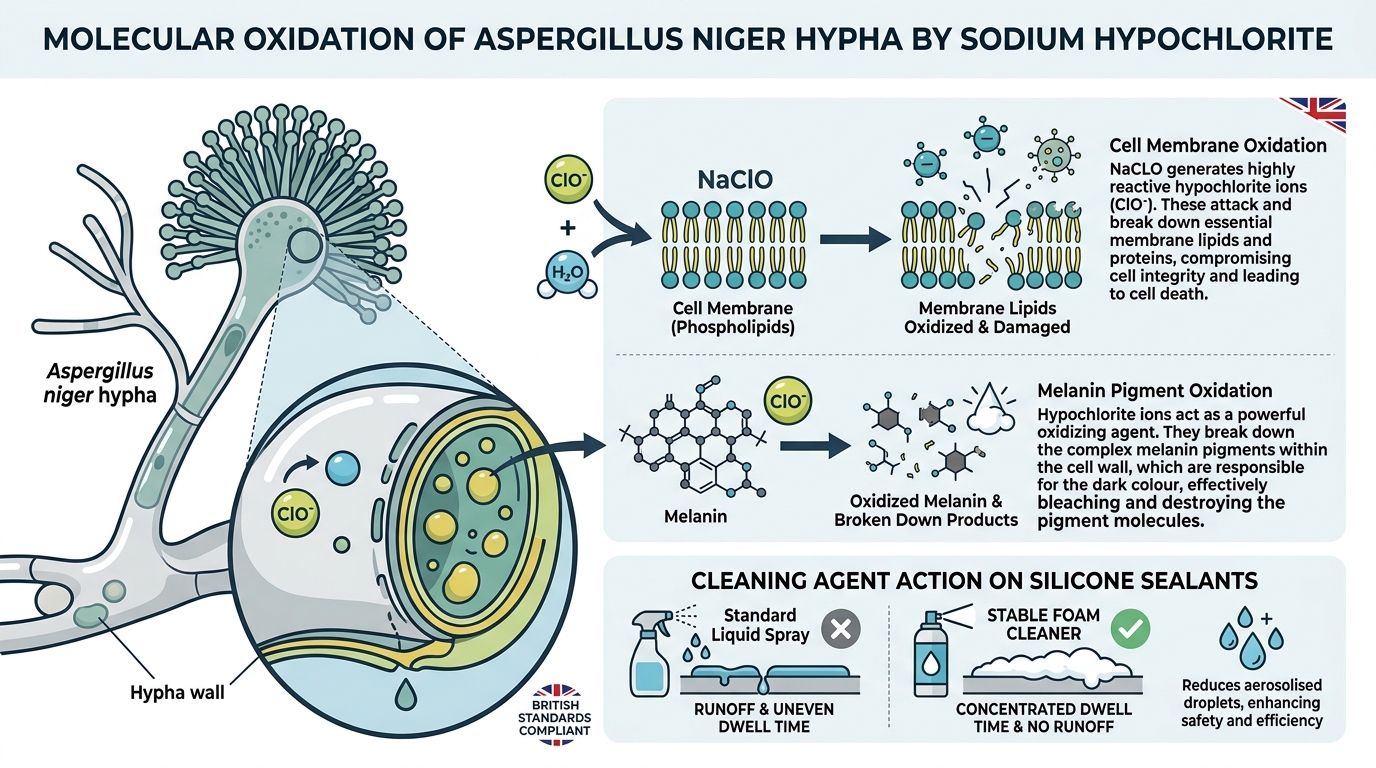
To eliminate established bathroom mould, a chemical treatment must deliver an effective biocide directly to the fungal root structure. The most common active ingredient in commercial mould sprays is sodium hypochlorite (NaOCl). Sodium hypochlorite is a strong oxidising agent that reacts with water to form hypochlorous acid (HOCl). This highly reactive acid readily penetrates the cell walls of fungi, where it oxidises essential proteins, lipids, and nucleic acids. Where products claim antibacterial or disinfectant properties, these actions are attributed to this oxidising pathway as described in manufacturer specifications.
In addition to its biocidal action, sodium hypochlorite acts as a bleaching agent. Bathroom mould owes its characteristic black or dark green colour to melanin, a dense pigment produced by the fungus to protect itself from environmental stress. Hypochlorous acid attacks the chemical structure of melanin, breaking the conjugated double bonds that absorb light. This molecular disruption renders the pigment colourless, resulting in the rapid whitening of black tile grout. However, this bleaching effect is superficial unless the chemical remains in contact with the surface long enough to reach deeper contamination. An SDS can identify chemical hazards and composition, but it cannot prove cleaning performance in isolation.
The physical delivery format of the biocide is as critical as its chemical concentration. Liquid sprays are highly fluid and cover broad areas rapidly, but they can suffer from gravity-driven runoff when applied to vertical shower tile walls. Foaming sprays incorporate surfactants that trap air upon exiting the nozzle, creating a stable foam that clings directly to vertical grout lines and silicone sealants. This stable foam reduces runoff, supporting longer contact time on the target mould whilst reducing the volume of chemical droplets aerosolised into the breathing zone.
Evaluation Criteria: Assessing Bathroom Mould Sprays
Each product was evaluated across five document-led criteria. These metrics focus on practical chemical parameters, safety standards, and physical delivery characteristics rather than unpublished laboratory testing.
- Chemistry and SDS profiles: disclosed sodium hypochlorite concentration range and solution pH.
- Surface dwell and runoff resistance: foam versus liquid format, especially on vertical grout joints.
- Application format and dwell time: manufacturer-recommended contact time and cleaning instructions.
- Safety and substrate cautions: SDS hazard classifications and manufacturer limitations for surfaces such as metal, wood, ceilings, rubber, and natural stone.
- Source limitations: nozzle reliability, odour intensity, and user handling issues are drawn from consolidated consumer feedback rather than SDS records.
Leading Bathroom Mould and Mildew Sprays Reviewed
1. HG Mould Remover Foam Spray (500ml)
HG Mould Remover Foam Spray (ASIN B01CRBEUVO) is a concentrated chemical treatment designed for targeted application on vertical bathroom surfaces. Its specialised nozzle aerates the sodium hypochlorite solution, generating a thick foam that clings to vertical tile joints, shower corners, and silicone sealants. According to the manufacturer product page, the foam format has a milder fragrance, produces less splashing, and allows easier direct application. The official usage instructions recommend spraying from three to five centimetres, allowing a dwell time of approximately 30 minutes, and then wiping the foam clean with a wet sponge.
- HG Mould Remover: Effortlessly eliminates all moulds, making filthy black stains disappear in under 30 minutes, whilst preventing re-growth
- Suitable for a wide range of surfaces: Removes mould & fungus from plastered walls, tiles, bathroom seals, grout, windows, outdoor furniture & more
- For indoor or outdoor use: Kills algae & mould marks around swimming pools, in the garage, shed, washing area, shower cubicle, sauna & conservatory
- Fast acting: This rapid use mould & mildew remover immediately cleans fungus marks from damp areas. The foam remains on the surface for longer & reduces splashing
- 500ml size HG Mould Foam Spray: Anti mould cleaner with a bleaching effect. Low odour formula. Test first in an inconspicuous place before applying
Specifications:
- Active ingredients disclosed in SDS: sodium hypochlorite 2-5%, sodium hydroxide 1-2%, sodium octyl sulphate 2-5%, 2-(2-dodecoxyethoxy)acetic acid 0.1-1%.
- Disclosed pH: 13.3.
- Physical format: viscous foaming spray.
- Recommended dwell time: approximately 30 minutes.
- Volume: 500 ml.
- Hazard classifications: H290, H314, H318, H400, H411.
- Document source: Wickes COSHH SDS, issue date 03/04/2024, version 1.0.
User friction and practical cautions:
Reviewers of the product frequently highlight physical friction with the safety lock on the trigger nozzle. Buyers also report that, although the foam format reduces droplet drift compared with liquid sprays, the product still releases an intense chlorine odour during the 30-minute dwell period. Active ventilation remains necessary. The SDS classification as corrosive to skin and eyes means gloves, eye protection, and careful rinsing are proportionate precautions, especially around metal fittings and nearby fabrics.

2. HG Mould Spray (500ml)
HG Mould Spray (ASIN B000IU40HQ) is a liquid-format chemical formula designed for broad-area oxidation on ceramic tiles, plaster walls, and external masonry. Unlike the foam version, this high-fluidity liquid penetrates rapidly into dry, porous grout lines but is more prone to runoff on vertical surfaces. Manufacturer guidance recommends spraying from three to five centimetres, leaving the product for 30 minutes, and then cleaning with water and a sponge. The manufacturer recommends gloves and thorough ventilation, and states that the spray is not recommended for ceilings, rubber fridge seals, or wood.

- The effective mould remover spray & mildew cleaner: Effortlessly eliminates all moulds, making filthy black stains disappear, whilst preventing re-growth
- Suitable for a wide range of surfaces: Removes mould & fungus from plastered walls, tiles, bathroom seals, grout, windows, outdoor furniture & more
- For indoor or outdoor use: Kills algae & mould marks around swimming pools, in the garage, shed, washing area, shower cubicle, sauna & conservatory
- Easy to use spray: Quick & simple to use directly onto mould or mildew in damp areas, with a targeted spray action to reduce splashing
- 500ml size HG Mould Spray: Anti mould cleaner with a bleaching effect. Test first in an inconspicuous place before applying
Specifications:
- Active ingredients disclosed in SDS: sodium hypochlorite 2-5%, sodium hydroxide 1-2%, 2-(2-dodecoxyethoxy)acetic acid 0.1-1%, sodium octyl sulphate 0.1-1%.
- Disclosed pH: >13.0.
- Physical format: liquid spray.
- Recommended dwell time: 30 minutes.
- Volume: 500 ml.
- Hazard classifications: H314, H318, H400, H411.
- Document source: Wickes COSHH SDS, issue date 27/03/2024, version 1.0.
User friction and practical cautions:
Reviewers frequently report intense chemical fumes and rapid liquid runoff. Because the formulation lacks the foam structure of the first-ranked HG product, it can drain down vertical shower walls and pool in the shower tray. This can increase chemical waste and airborne chlorine odour, especially when users reapply the spray to compensate for runoff. The product remains chemically strong, but its liquid format makes it less forgiving on vertical bathroom surfaces.
3. Astonish Mould & Mildew Blaster (750ml)
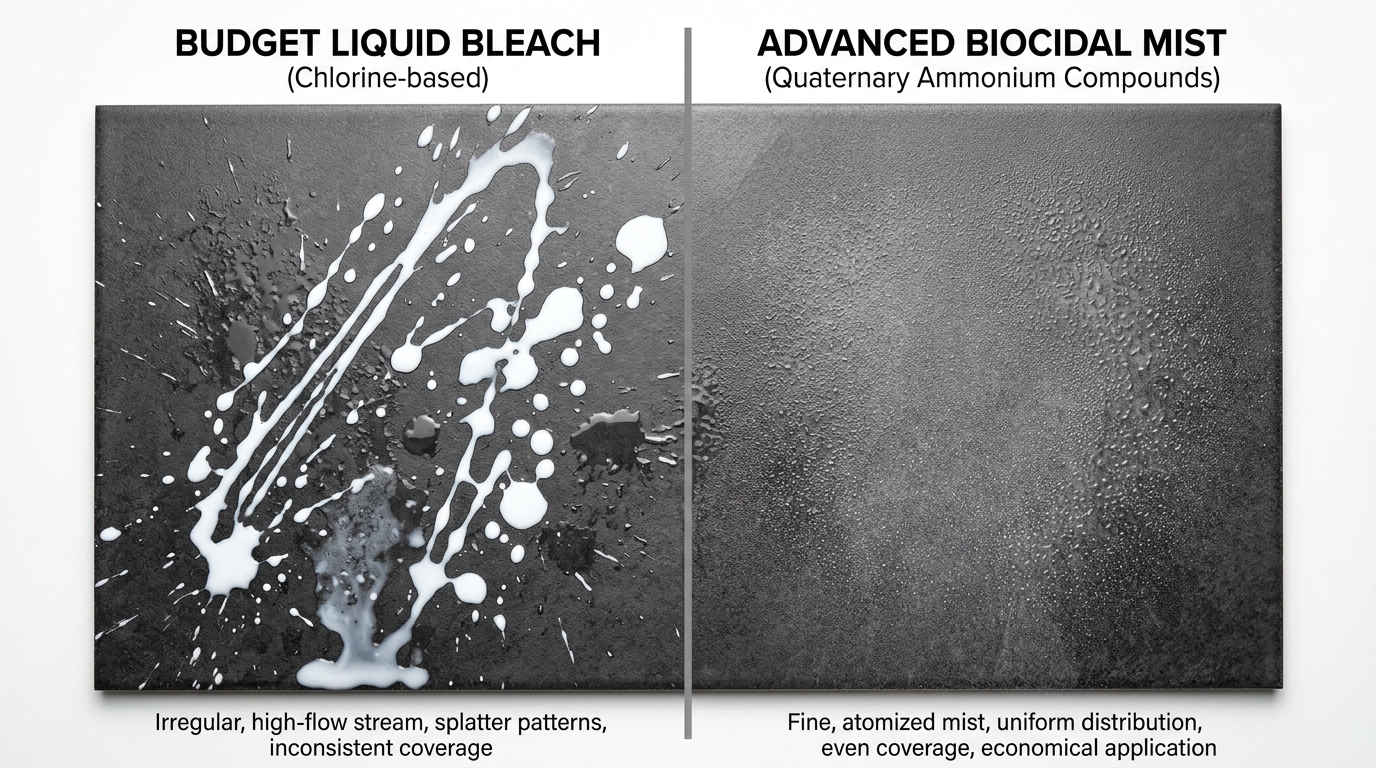
Astonish Mould & Mildew Blaster (ASIN B07QL3CQDL) is a budget-friendly UK-made option. The SDS identifies sodium hypochlorite as the main active ingredient, and alternate SDS versions also disclose a phosphonate blend below 1%. Its lower price and larger 750 ml volume make it attractive for occasional spot treatment or broad surface cleaning, although the liquid format still requires careful handling around fabrics, silicone, and metal fittings.

- Astonish Mould and Mildew Blaster
Specifications:
- Active ingredient disclosed in SDS: sodium hypochlorite 1-5%.
- Disclosed pH: 12.0-13.7.
- Physical format: liquid spray.
- Recommended dwell time: 3 to 5 minutes.
- Volume: 750 ml.
- Hazard classifications: H315, H319.
- Document source: London Oil Refining Company SDS, revision date 21/09/2021, version 10.1.
User friction and practical cautions:
Reviewers of the product report occasional trigger-pump failures, leakage around the spray head, and inconsistent spray patterns. The comparatively low price should therefore be weighed against mechanical reliability and the higher likelihood of splashing from a liquid spray. The SDS classification is less severe than the corrosive classification carried by several competitors, but eye and skin irritation risks remain material.
4. Cillit Bang Power Cleaner Black Mould Remover (750ml)
Cillit Bang Power Cleaner Black Mould Remover (ASIN B00XVJG1HI) is a strong household cleaning spray formulated for rapid action against stubborn bathroom stains. The SDS identifies sodium hypochlorite at 2.19 g per 100 g, with a disclosed Section 3 concentration of up to 2.4%. Its pH range of 12.2-12.8 and corrosive hazard classification indicate a powerful alkaline bleach system that requires careful use around skin, eyes, metals, and delicate bathroom finishes.
No products found.
Specifications:
- Active ingredient disclosed in SDS: sodium hypochlorite ≤2.4%, specifically 2.19 g per 100 g.
- Disclosed pH: 12.2-12.8.
- Physical format: liquid spray.
- Recommended dwell time: 5 minutes.
- Volume: 750 ml.
- Hazard classifications: H314, H318.
- Document source: Janitorial Express / Reckitt SDS, issue date 10/03/2023, version 1.0.
User friction and practical cautions:
Reviewers warn that the strong surfactant-bleach combination can tarnish or etch sensitive metals if left on chrome, brass, or anodised aluminium. The product’s liquid spray format also increases the chance of overspray and fume exposure in enclosed shower cubicles. The corrosive SDS classification means it should be handled as a high-risk domestic bleach product rather than a general-purpose bathroom cleaner.
5. Dettol Antibacterial Mould & Mildew Remover (750ml)
Dettol Antibacterial Mould & Mildew Remover (ASIN B00W3AMF76) combines the Dettol brand’s antibacterial positioning with active chlorine stain removal. The SDS identifies sodium hypochlorite at 2.19 g per 100 g and non-ionic surfactants below 5%, with a pH range of 12.2-12.8. The manufacturer label claim of killing bacteria and viruses should be read as a manufacturer claim rather than a claim independently verified by Science of Fresh laboratory testing.

- Specially formulated with a powerful bleach
- Removes even ingrained mould and mildew
- Kills 99.9% of bacteria and viruses
- Suitable for cleaning chrome, stainless steel, glazed ceramic tiles, white grouting etc
Specifications:
- Active ingredient disclosed in SDS: sodium hypochlorite 2.19 g per 100 g, with <5% non-ionic surfactants.
- Disclosed pH: 12.2-12.8.
- Physical format: liquid spray.
- Recommended dwell time: 5 minutes.
- Volume: 750 ml.
- Hazard classifications: H302, H314. Signal word: Warning.
- Document source: Viking SDS / Reckitt EU PSDS D8354616, issue date 05/10/2021, version 1.0.
User friction and practical cautions:
Reviewers frequently report trigger-head failures, including sticking mechanisms and reduced pump output after several cleaning sessions. As with other liquid sprays, droplet drift and vertical runoff can lead to accidental bleaching of nearby towels, shower curtains, and bath mats. The SDS classification as corrosive means users should avoid casual application and instead treat it as a strong alkaline bleach product requiring gloves, ventilation, and careful rinsing.
Bathroom Mould Spray Comparison Matrix
The disclosed specifications are summarised in the following comparative matrix. These figures describe SDS composition and hazard information, not independent laboratory performance results.
| Product Name | Sodium Hypochlorite Range | Disclosed pH | Physical Format | Mfr. Dwell Time | Key Hazard Classification |
|---|---|---|---|---|---|
| HG Mould Remover Foam Spray | 2-5% | 13.3 | Thick foam | Approx. 30 mins | H290, H314, H318 |
| HG Mould Spray | 2-5% | >13.0 | Liquid spray | 30 mins | H314, H318 |
| Astonish Mould & Mildew Blaster | 1-5% | 12.0-13.7 | Liquid spray | 3-5 mins | H315, H319 |
| Cillit Bang Mould & Mildew Remover | ≤2.4% (2.19%) | 12.2-12.8 | Liquid spray | 5 mins | H314, H318 |
| Dettol Mould & Mildew Remover | 2.19% | 12.2-12.8 | Liquid spray | 5 mins | H302, H314 |
Application and Safety Guide: Maximising Biocidal Efficacy
Selecting and applying a bathroom mould treatment requires a careful balance of chemical efficacy and domestic safety. Because the most effective products rely on sodium hypochlorite at high pH levels, they are inherently corrosive and release strong respiratory irritants. The SDS evidence above supports treating these products as strong bleach-based chemical systems, not routine daily bathroom sprays.
- Prioritise bathroom ventilation: open windows, use the extractor fan, and avoid spraying in a sealed room.
- Wear appropriate protection: gloves and eye protection are proportionate for products carrying H314 or H318 classifications.
- Pre-clean soap scum: sodium hypochlorite reacts with organic residues, so removing surface grime first improves the chance of effective contact with mould.
- Protect sensitive fixtures: chrome, brass, anodised aluminium, fabrics, and some sealants may be damaged by overspray or prolonged contact.
- Respect dwell times: follow the manufacturer’s instructions rather than assuming stronger bleach means shorter contact time.
- Recognise the silicone limitation: if black mould has penetrated behind detached silicone sealant, chemical sprays may bleach the surface but cannot reliably remove growth beneath the sealant. Replacement is often required.

Our Final Verdict: Choosing the Right Mould and Mildew Spray
Based on SDS specifications, manufacturer usage guidance, physical delivery formats, and consolidated customer feedback, the strongest recommendation is not simply the product with the highest apparent bleach strength. For bathroom use, the decisive factor is whether the active chemistry remains where it is needed for long enough to work without excessive runoff, splash, or fume exposure.
#1 Best Overall: HG Mould Remover Foam Spray (500ml)
We recommend HG Mould Remover Foam Spray (ASIN B01CRBEUVO) as the #1 Best Overall bathroom mould treatment in this comparison. Its SDS discloses a 2-5% sodium hypochlorite concentration, sodium hydroxide at 1-2%, and a pH of 13.3, placing it among the stronger alkaline bleach systems reviewed. Its advantage over liquid sprays is not simply chemistry; it is delivery. The foam format is better aligned with vertical grout joints and silicone sealants because it reduces runoff and supports the manufacturer-specified 30-minute dwell period. The caveat is safety: its corrosive classification means it requires gloves, eye protection, ventilation, and careful rinsing around metal fixtures.
Best budget option: Astonish Mould & Mildew Blaster (750ml)
Astonish offers strong value for occasional mould treatment, with a large 750 ml bottle and an SDS-disclosed sodium hypochlorite range of 1-5%. Its irritant classification is less severe than the corrosive classification carried by several competitors, but trigger reliability and liquid-spray runoff remain practical drawbacks.
Most powerful liquid option: HG Mould Spray (500ml)
HG Mould Spray remains the strongest liquid-format choice on paper, with 2-5% sodium hypochlorite and pH above 13. It is appropriate for broad or porous surfaces where liquid penetration matters, but its runoff and fume profile make it less suitable than the foam version for vertical shower cubicles.
Editorial summary:
The evidence favours matching chemistry to delivery format. Liquid sprays are cheaper and cover large areas quickly, but they are less controlled on vertical bathroom surfaces. Foam delivery gives the active chlorine system more time in contact with grout and sealant lines, which is why HG Mould Remover Foam Spray earns the top recommendation despite its higher price and stricter safety requirements.