
The cleaning and air care aisle of any supermarket presents a bewildering array of products that promise to eliminate household odours. Yet the language on these labels varies significantly: some claim to “neutralise,” others to “eliminate,” “absorb,” or simply “freshen.” These are not interchangeable marketing terms: they describe fundamentally different chemical and sensory mechanisms for dealing with unwanted smells.
Understanding the difference between odour neutralisation and fragrance masking is essential for anyone who wants to make informed purchasing decisions. The wrong approach leaves the source of the odour intact, resulting in temporary relief followed by the gradual return of the original smell. This article explains the science behind each method, their practical limitations, and how to identify which approach a product actually uses.
What Is Fragrance Masking?
Fragrance masking is the oldest and most widely used approach to odour management. It works on a sensory principle rather than a chemical one: a strong, pleasant fragrance is introduced into the environment at a concentration high enough to overwhelm the olfactory system’s ability to detect the malodour. The unpleasant smell molecules remain physically present in the air and on surfaces, but the brain prioritises processing the stronger signal from the fragrance molecules .
This phenomenon is well-documented in olfactory science. The human nose contains approximately 400 functional olfactory receptor types, each capable of detecting multiple odorant molecules. When competing odorants are present simultaneously, the olfactory system exhibits a phenomenon called suppression: the perception of one odour is reduced by the presence of another. A sufficiently intense fragrance can suppress the perception of a malodour entirely, even though the chemical concentration of the malodour remains unchanged .
Common masking products include:
- Aerosol air fresheners and plug-in diffusers
- Fragranced cleaning sprays and multi-surface cleaners
- Scented candle and wax melts
- Carpet powders and fabric fresheners
- Many “odour control” products that contain only fragrance and no active neutralising ingredients
The key limitation: Masking does not remove, alter, or destroy the molecules responsible for the malodour. The source remains fully intact. Once the fragrance dissipates through evaporation, ventilation, or olfactory adaptation (the phenomenon where the nose becomes temporarily desensitised to a continuous smell), the underlying malodour becomes detectable again. This is why a fragranced product can make a room smell pleasant for an hour or two, but the original smell returns undiminished.
There is a further risk: the combination of a strong synthetic fragrance with certain malodours, particularly organic odours such as urine, vomit, or sewage, can produce hybrid smells that are more unpleasant than either component alone. This is the well-known phenomenon of “air freshener plus pet odour” producing a confectionery-like smell that many people find distinctly disagreeable.
What Is Odour Neutralisation?
Odour neutralisation encompasses several distinct chemical and physical mechanisms that reduce or eliminate malodour molecules directly, rather than relying on sensory overload. These mechanisms can be categorised as follows:
Chemical Neutralisation
This mechanism involves a direct chemical reaction between a neutralising agent and the malodour molecule. The reaction alters the molecular structure of the odour-causing compound, converting it into a different substance that either has no odour or has a significantly lower odour intensity .

Common examples include:
- Acid-base reactions: Alkaline odour compounds such as ammonia can be neutralised by acidic compounds, forming odourless salts. Conversely, acidic odours such as fatty acids can be neutralised by alkaline agents.
- Oxidation: Oxidising agents including hydrogen peroxide, sodium percarbonate, and chlorine dioxide react with the sulphur and nitrogen atoms in malodour molecules, breaking their chemical bonds and rendering them odourless. This is the mechanism behind many oxi-action cleaning products.
- Metal salt complexation: Zinc ricinoleate, a castor-oil derivative, forms stable complexes with sulphur-containing compounds, amines, and fatty acids. The malodour molecule is chemically bound to the zinc salt, preventing it from volatilising and reaching the nose. This is widely used in modern, fragrance-free odour neutralisers .
Molecular Binding and Encapsulation
Rather than altering the chemical structure of malodour molecules, binding agents physically trap them within a host structure, preventing their release into the air. Key examples include:
- Cyclodextrins: These ring-shaped sugar molecules have a hydrophobic interior cavity that can encapsulate a wide range of volatile organic compounds responsible for malodour. The malodour molecule becomes trapped inside the cyclodextrin ring and can no longer volatilise.
- Activated charcoal and zeolites: These porous materials have an enormous internal surface area (a single gram of activated charcoal can have a surface area exceeding 500 square metres). Malodour molecules are adsorbed onto this surface through weak chemical bonds, effectively removing them from the air.
Enzymatic Digestion
Enzymatic cleaners introduce biological catalysts that break down the organic compounds producing the malodour. This is fundamentally different from masking, chemical neutralisation, or physical absorption: it removes the food source for odour-producing bacteria rather than merely containing or transforming the odour molecules themselves. Enzymatic digestion is particularly effective for organic stains and odours including urine, faeces, vomit, and food spills .
Direct Comparison: Neutralisation vs Masking
| Characteristic | Fragrance Masking | Odour Neutralisation |
|---|---|---|
| Mechanism | Sensory: overwhelms olfactory receptors with fragrance | Chemical or physical: alters, traps, or digests malodour molecules |
| Malodour molecules removed? | No. Malodour remains chemically unchanged. | Yes. Molecules are altered, bound, or digested. |
| Duration of effect | Temporary: lasts only while fragrance is detectable | Permanent for treated molecules: effect lasts until new odour source appears |
| Risk of hybrid odours | High: fragrance + malodour can produce unpleasant combinations | Low: neutralisation eliminates the malodour rather than mixing with it |
| Speed of action | Instant: perception changes immediately on exposure | Variable: chemical reactions may take minutes; enzymatic digestion takes hours |
| Suitable for | Mild or transient odours, ambience enhancement | Persistent odours, organic stains, pet accidents, smoke, cooking smells |
| Fragrance required? | Yes: the fragrance is the active mechanism | Optional: many neutralisers are fragrance-free or use minimal natural scents |
Combination Products: The Best of Both Worlds?
Many modern odour-control products combine neutralising agents with carefully selected fragrances. These products aim to deliver the immediate sensory satisfaction of a pleasant scent alongside the long-term benefit of chemical neutralisation. When formulated correctly, this approach offers a practical compromise: the fragrance provides instant freshness, whilst the neutralising chemistry works over time to eliminate the source of the malodour .
However, the presence of a fragrance on the label does not necessarily indicate that the product contains any neutralising chemistry. Many products marketed as “odour eliminators” are, in reality, fragranced masking agents with no active neutralising ingredients. The fragrance itself is the only odour-control mechanism. Consumers should look for specific active ingredients such as zinc ricinoleate, cyclodextrins, enzymatic cultures, or oxidising agents, rather than relying on marketing claims .
It is also worth noting that some malodour compounds, particularly those from bacterial decomposition, require elimination rather than neutralisation. The bacteria continue producing new malodour molecules as they metabolise organic matter. In these cases, antimicrobial or enzymatic treatment is necessary to address the biological source, not just the chemical odour molecules already present.
How to Choose the Right Approach
The choice between masking and neutralisation depends on the nature of the odour and the context in which it occurs:
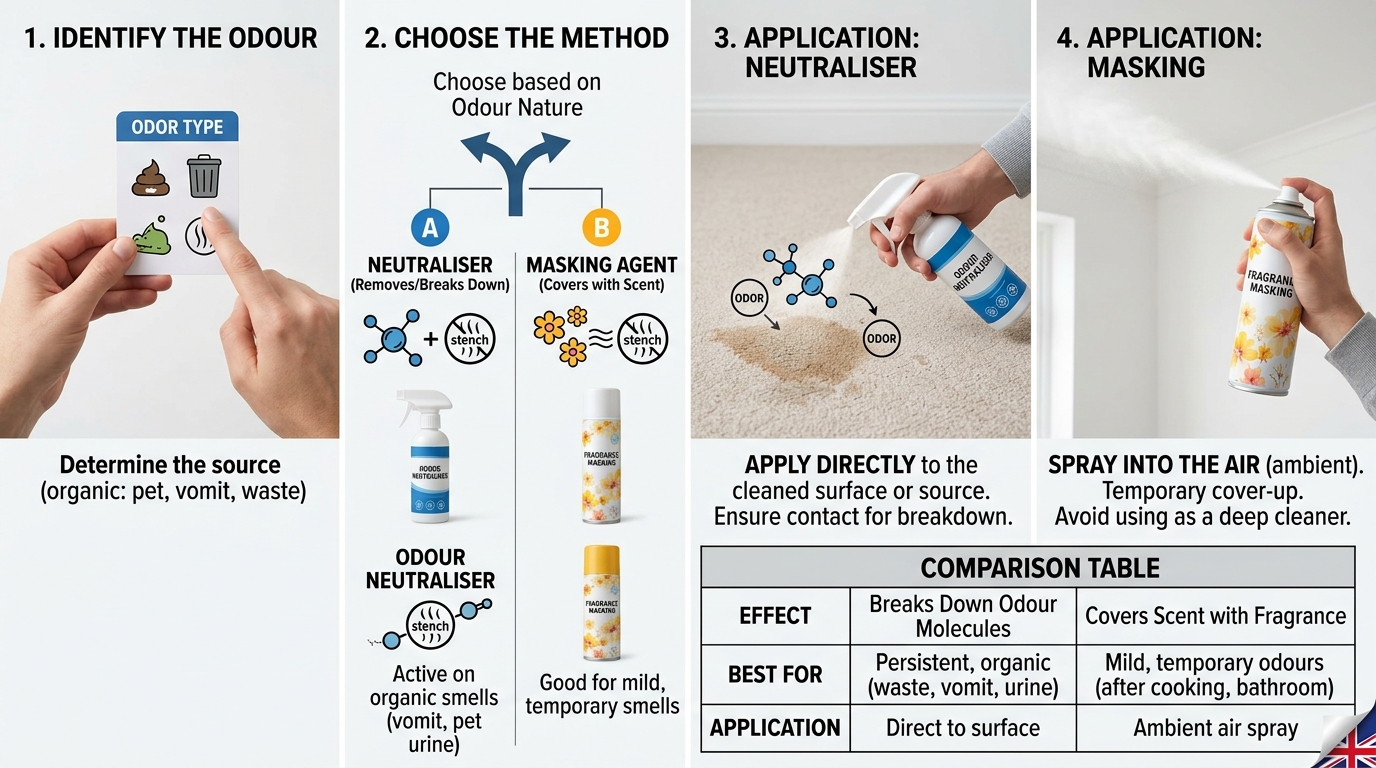
- For persistent organic odours (pet accidents, vomit, urine): Use an enzymatic cleaner or an oxidising neutraliser. Fragrance masking will provide only temporary relief and may produce unpleasant hybrid smells.
- For ambient freshening between cleans: A fragrance-only product may be sufficient for mild background odours, but consider a neutralising alternative for more effective, longer-lasting results.
- For smoke, cooking, or chemical odours: Choose products containing activated charcoal, zeolites, or oxidising agents that can physically remove or chemically alter the airborne molecules responsible.
- For fabric and upholstery odours: Avoid fragranced sprays that may leave residue. Cyclodextrin-based neutralisers or enzymatic fabric refreshers are more effective and fabric-safe.
- For sensitive households (babies, pets, respiratory conditions): Fragrance-free neutralisers based on zinc ricinoleate or enzymatic action are preferable, as they avoid the respiratory irritation that heavy synthetic fragrances can cause.
Frequently Asked Questions
How can I tell if a product is a neutraliser or just a masking agent?
Check the ingredients list for active neutralising compounds: zinc ricinoleate, cyclodextrins, sodium percarbonate (oxygen bleach), hydrogen peroxide, or specific enzyme cultures (protease, lipase, amylase). If the ingredients list contains only fragrance oils, surfactants, and preservatives, the product is likely a masking agent regardless of its marketing claims. Products that list only “perfume” or “fragrance” as their active odour-control ingredient are not true neutralisers.
Are fragrance-free odour neutralisers as effective as fragranced ones?
Fragrance-free neutralisers are often more effective at eliminating malodour because they rely entirely on chemical or physical mechanisms rather than sensory masking. Products containing zinc ricinoleate or cyclodextrins can neutralise a broad spectrum of odour molecules without adding any fragrance. The perception of efficacy with fragranced products can be misleading: the smell may seem reduced, but the malodour molecules remain present and will become detectable again once the fragrance dissipates.
Can I combine a neutralising product with a fragranced product?
In most cases, yes. Using a neutralising product to eliminate the source of the malodour, followed by a light fragrance for ambience, is a sensible approach. However, avoid mixing different cleaning products simultaneously, as incompatible chemistries (such as enzymes and bleach) can neutralise each other. Apply the neutraliser first, allow it to work, and then introduce fragrance if desired.
Why do some “odour neutralising” products still contain strong fragrances?
Fragrance is added to many neutralising products for two reasons: consumer expectation and immediate gratification. Most buyers associate a pleasant smell with cleanliness, and a fragrance-free product may be perceived as less effective even when its neutralising chemistry is superior. The fragrance provides an immediate sensory signal of freshness while the slower neutralising chemistry works in the background. This dual-action approach can be effective, but the quality of the neutralising chemistry matters far more than the fragrance quality.
Summary: Making Informed Choices
Fragrance masking and odour neutralisation represent fundamentally different philosophical approaches to malodour management. Masking addresses the perception of smell; neutralisation addresses its physical source. One provides temporary relief; the other offers permanent elimination.
For routine ambient freshening in a well-maintained home, a high-quality fragrance may be perfectly adequate. But for persistent, organic, or biologically sourced odours, only neutralisation chemistry will produce lasting results. Understanding the difference empowers consumers to select products that genuinely solve their odour problems rather than temporarily concealing them.
The most effective approach for any household is a layered strategy: use neutralising products to eliminate malodour sources at the molecular level, and reserve fragranced products for the purely cosmetic purpose of adding a pleasant ambiance to an already clean and fresh environment.