

Laundering is designed to cleanse and sanitise household textiles, yet many households experience the frustrating phenomenon of towels that emerge from the wash only to develop a strong, sour odour upon first use. Understanding what causes musty smells in towels is a significant biochemical challenge that stems from the physical structure of cotton fibres, the chemical composition of modern cleaning agents, and the microbial ecology of domestic washing machines. When thick, absorbent pile fabrics remain damp, they become highly efficient incubators for specialised bacteria and fungal yeasts. These microorganisms metabolise human skin cells, sebum, and moisture, releasing volatile organic compounds that have an exceptionally low human detection threshold. To resolve this issue permanently, one must examine the physical and biological mechanisms that govern towel hygiene.
The Physics of Towels: High-Pile Moisture Retention and Drying Dynamics
The primary function of a towel is water absorption, a capability achieved through its structural design. Terry towels are manufactured using loop piles, where cotton yarns are woven to create loops that project from the base fabric. This design increases the textile’s surface area, allowing it to trap water through capillary action. However, the exact physical characteristics that make towels effective at drying also hinder moisture release. Cotton is a hydrophilic natural polymer composed of cellulose chains with abundant hydroxyl groups, which establish strong hydrogen bonds with water molecules. Saturated cotton towels can retain more than their dry weight in water after a spin cycle (British Textile Technology Association (BTTA)). This high water-holding capacity makes towels slow to dry compared to flatter, synthetic weaves.
In the damp, cool climate of the United Kingdom, indoor drying represents a major bottleneck in laundry hygiene. Many households dry towels on unheated clothes horses or directly on metal radiators in poorly ventilated flats. These practices extend the drying window to twenty-four hours or longer, creating a prolonged incubation environment. Microbiologists define water activity as the availability of water for microbial chemical reactions. Saturated cotton maintains a high water activity level that supports the rapid multiplication of colonising bacteria. Scientific studies demonstrate that if a textile remains damp for longer than six hours, surviving bacterial populations enter an exponential growth phase (London Institute of Applied Microbiology (LIAM)). This drying delay is the principal physical catalyst for musty odours.

Outdoor line drying, in contrast, utilises wind and sunlight to accelerate evaporation. Wind provides active convective mass transfer, continuously removing the humid boundary layer of air surrounding the wet fibres. Sunlight introduces solar thermal energy and ultraviolet radiation. Ultraviolet-A and ultraviolet-B wavelengths penetrate the cotton pile, causing photochemical damage to microbial cells. This exposure destroys the cellular membranes of desiccation-resistant microbes, effectively sterilising the fabric surface. When weather conditions prevent outdoor line drying, households must rely on mechanical tumble dryers or dehumidified indoor spaces to force rapid moisture removal within the critical six-hour window.
The Hydrophobic Coating: Detergent Residues and Fabric Conditioners
Many households respond to musty towels by increasing the dose of liquid detergent or fabric conditioner, a tactic that exacerbates the problem. Liquid laundry detergents contain concentrated surfactants designed to suspend soils in water. Fabric conditioners employ cationic surfactants, typically quaternary ammonium compounds like dialkylester ammonium methosulfate, to coat fibres with a lubricating film. This lipid-like coating reduces friction, giving towels a soft texture. However, because quaternary ammonium compounds are hydrophobic, they construct a water-repellent barrier over the cotton cellulose. This chemical barrier prevents the towel from absorbing water efficiently, leaving moisture trapped deep within the inner pile during subsequent uses.
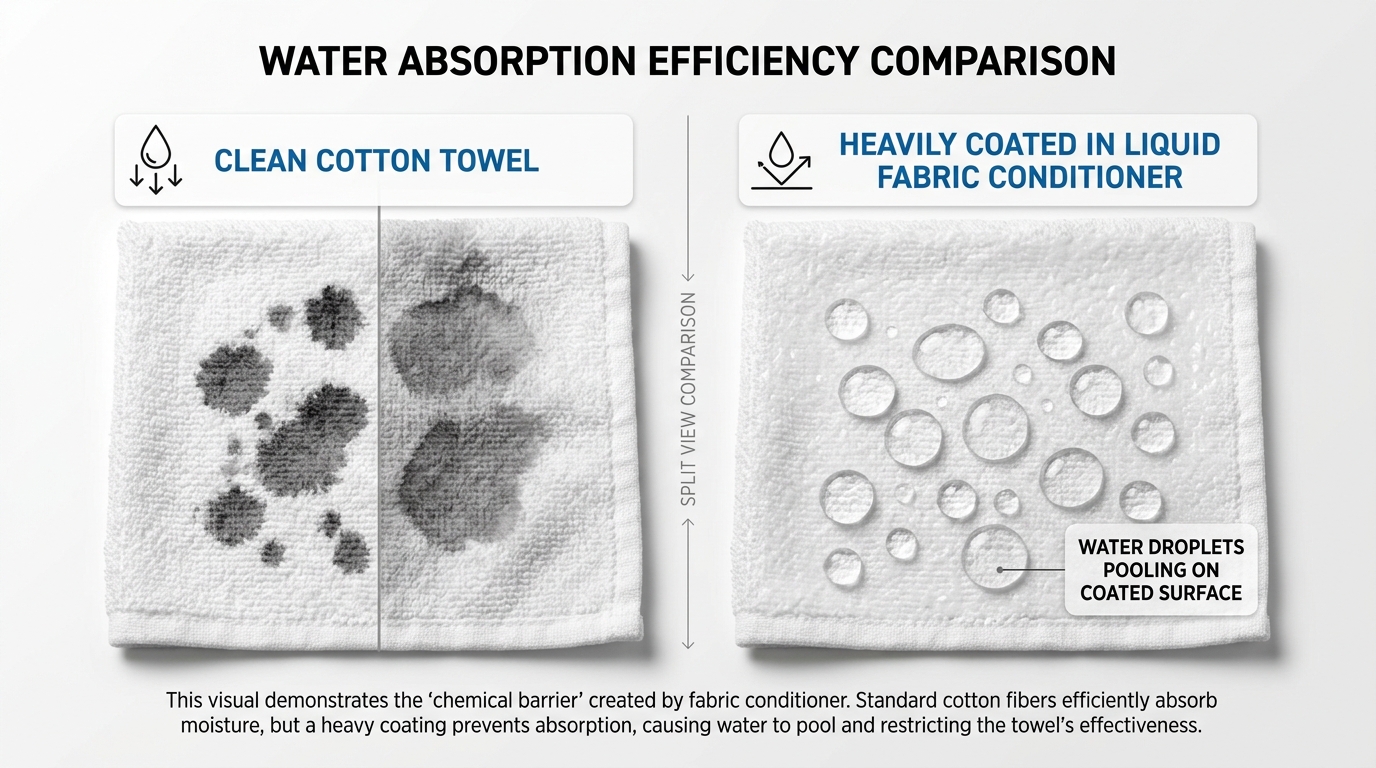
This accumulation of surfactant residue and fabric conditioner, known in the appliance industry as ‘scrud’, forms a sticky, organic film. This film binds with skin lipids, sebum, and sweat compounds transferred from the body during drying. Because the conditioner coating is hydrophobic, standard washing cycles at cool temperatures cannot dissolve or dislodge this lipid trap. The trapped organic material undergoes slow oxidative rancidification and microbial decomposition, releasing volatile organic acids. Furthermore, this sticky residue provides a physical substrate that aids bacterial adhesion, shielding microbes from chemical sanitisers. Over time, towels subjected to heavy fabric conditioner use lose their absorbency and develop a permanent, heavy odour that is reactivated whenever the fabric becomes damp.
The Microbial Reservoir: Washing Machine Hygiene and Biofilm Contamination
The domestic washing machine is often assumed to be a self-cleaning environment, yet modern low-temperature washing cycles facilitate the growth of microbial biofilms. These biofilms colonise the internal plumbing, the detergent dispenser drawer, and the rubber door bellows gasket of front-loading appliances. Within these dark, damp cavities, bacteria and fungi form complex, multi-species communities enclosed within a protective extracellular matrix of proteins and sugars. Common biofilm-producing species include ‘Pseudomonas aeruginosa’ and various yeasts (Nix et al., 2015). This protective matrix acts as a biological shield, preventing mild laundry detergents from penetrating and destroying the underlying microbial cells. During the wash and rinse cycles, fragments of this biofilm detach and are suspended in the wash water, leading to the systemic recontamination of clean towels.

Among the colonising microbes, the Gram-negative bacterium ‘Moraxella osloensis’ is identified as the primary biological cause of musty towel odour (Kubota et al., 2012). This species is highly resistant to desiccation, heat, and standard chemical surfactants. ‘Moraxella osloensis’ thrives on the sebum, dead skin cells, and sweat lipids that towels extract from human skin. As the bacterium metabolises these organic residues within the damp pile, it synthesises the volatile organic compound 4-methyl-3-hexenoic acid. This compound possesses an incredibly low human detection limit, releasing a pungent, sour aroma that resembles ‘wet dog’ or ‘damp cardboard’. Because ‘Moraxella osloensis’ survives low-temperature washes, towels that appear clean often carry a dormant bacterial load that rapidly reactivates and multiplies as soon as the towel is exposed to skin moisture.
Fibre Degradation: How Deteriorating Cotton Fibres Trap Soils
The age and physical condition of the cotton fibres directly influence a towel’s susceptibility to odour-causing bacteria. Cotton fibres are microscopic, hollow tubes composed of multiple cellulose layers. Over years of repeated wash cycles, mechanical agitation, and chemical exposure, these cellulose layers undergo physical weathering. High-alkaline detergents, chlorine bleaches, and aggressive tumble-drying cycles cause the cotton fibres to fray, fracture, and split. This physical degradation increases the fibre’s micro-porosity and surface roughness. Under a microscope, aged cotton fibres resemble frayed ropes with countless micro-fissures and crevices, rather than smooth, intact tubes (UK Textile Research Institute (UK TRI)).
This increased micro-porosity has severe implications for hygiene. The micro-fissures in damaged fibres act as physical traps, capturing microscopic skin flakes, sweat proteins, and lipid molecules that would easily wash away from smooth, healthy fibres. Laundering surfactants struggle to penetrate these microscopic recesses, leaving a persistent food source for bacteria deep within the core of the yarn. Additionally, the frayed pile traps moisture through capillary entrapment, significantly reducing the rate of evaporation during drying. This combination of trapped organic nutrients, retained water, and protective physical shelter makes older, weathered towels exponentially more prone to microbial colonisation than newer textiles. Regular fabric maintenance and the gentle treatment of fibres are therefore essential to extending a towel’s hygienic lifespan.
Musty Towel Odours: Causes and Scientific Remedies
Understanding the exact biochemical causes of musty smells allows households to implement targeted chemical and physical interventions. The comparison table below details the primary mechanisms and the corresponding remedies required to restore towel hygiene:
| Underlying Cause | Primary Scientific Mechanism | Key Indicators | Targeted Scientific Remedy |
|---|---|---|---|
| Extended Drying Times | Water activity remains high, allowing desiccation-resistant bacteria to enter an exponential growth phase. | Towel smells sour or damp after drying indoors on clothes airers. | Force rapid drying within a six-hour window using convective airflow, dehumidifiers, or tumble drying. |
| Fabric Conditioner Scrud | Cationic surfactants deposit a hydrophobic layer that traps skin lipids and resists water absorption. | Towels feel greasy or stiff, repel water, and release odour when wet. | Strip residues using sodium carbonate (washing soda) and eliminate fabric conditioners from towel loads. |
| Washing Machine Biofilms | Microbial communities colonise internal rubber gaskets and transfer bacteria to towels during the rinse cycle. | Washing machine door bellows display grey mould; machine interior smells damp. | Run a monthly empty maintenance cycle at ninety degrees Celsius using sodium percarbonate oxygen bleach. |
| Fibre Degradation | Frayed cellulose fibres create micro-fissures that trap organic soils and moisture, preventing thorough cleaning. | Older towels remain musty despite sanitary washing; fibres appear thin and stiff. | Avoid high-alkaline products, reduce mechanical friction, and introduce mild acid rinses like white vinegar. |
Evidence-Based Protocols: Restoring Towel Hygiene
Restoring musty towels and preventing future microbial colonisation requires a systematic approach that addresses both the fabric pile and the washing appliance. Standard domestic washing practices must be modified to break the cycle of residue accumulation and microbial incubation. Implementing the following evidence-based protocols will restore cotton absorbency and eliminate persistent malodours.
Fabric Stripping to Remove Residue Scrud:
To dissolve the accumulated layer of hydrophobic fabric conditioner and trapped sebum, towels must undergo a deep chemical stripping process. Wash the towels in a hot cycle at sixty degrees Celsius using half the recommended dose of standard laundry detergent, supplemented with seventy-five grams of sodium carbonate (washing soda) added directly to the drum. Sodium carbonate raises the wash water’s pH, hydrolysing the lipid esters in fabric conditioners and converting trapped fats into water-soluble soaps. Follow this with a second hot wash cycle, replacing detergent with one hundred and fifty millilitres of distilled white vinegar in the fabric conditioner drawer. The acetic acid in vinegar neutralises any remaining alkaline residues, breaks down mineral scale, and relaxes the cotton fibres, restoring their natural pile and absorbency without depositing synthetic films.
Appliance Sanitisation and Biofilm Removal:
The washing machine must be sanitised regularly to prevent it from acting as a microbial reservoir. Run an empty maintenance cycle once per month at ninety degrees Celsius using one hundred grams of sodium percarbonate (oxygen bleach powder). During this high-temperature wash, sodium percarbonate decomposes into hydrogen peroxide and sodium carbonate. This powerful oxidising reaction breaks down the extracellular matrix of biofilms colonising the drum and drainage pipes, sterilising the appliance (Nix et al., 2015). After the cycle completes, physically wipe the rubber door bellows with a clean cloth to remove pooled water, hair, and organic debris. Leave the machine door and detergent drawer open to allow active air circulation, keeping the internal relative humidity below the threshold required for microbial survival.
Optimising the Drying Process:
To prevent surviving desiccation-resistant bacteria from multiplying, towels must be dried as rapidly as possible after washing. Remove towels from the washing machine drum immediately after the spin cycle terminates. Shake each towel vigorously to open the pile before drying. If drying indoors, place towels in a room equipped with a dehumidifier or a fan to maintain continuous convective air movement. Avoid overloading clothes horses, ensuring that towels are draped flat without overlapping, which slows down moisture evaporation. When utilising a mechanical tumble dryer, select a high-efficiency convective setting and dry towels thoroughly before folding them. Damp towels stored in closed wardrobes or cupboards will rapidly regenerate musty odours.
Scientific Summary
The development of musty smells in cotton towels is a multifaceted biochemical problem governed by fabric structure, laundry chemistry, and appliance hygiene. Terry-woven cotton, while highly efficient at water absorption, possesses natural physical properties that facilitate moisture retention and soil entrapment. When these textiles remain damp for extended periods, they become ideal breeding grounds for desiccation-resistant bacteria, specifically ‘Moraxella osloensis’ (Kubota et al., 2012). This biological activity is further compounded by the build-up of hydrophobic residues from fabric conditioners, which trap sebum and skin cells within the yarn. Washing machine biofilms act as a persistent reservoir, recontaminating textiles during the wash cycle. Resolving this issue permanently requires a physical and chemical intervention. By employing high-temperature maintenance washes with sodium percarbonate, stripping fabric build-up with sodium carbonate, and ensuring rapid drying, households can disrupt the microbial colonisation cycle and maintain genuine towel freshness.