
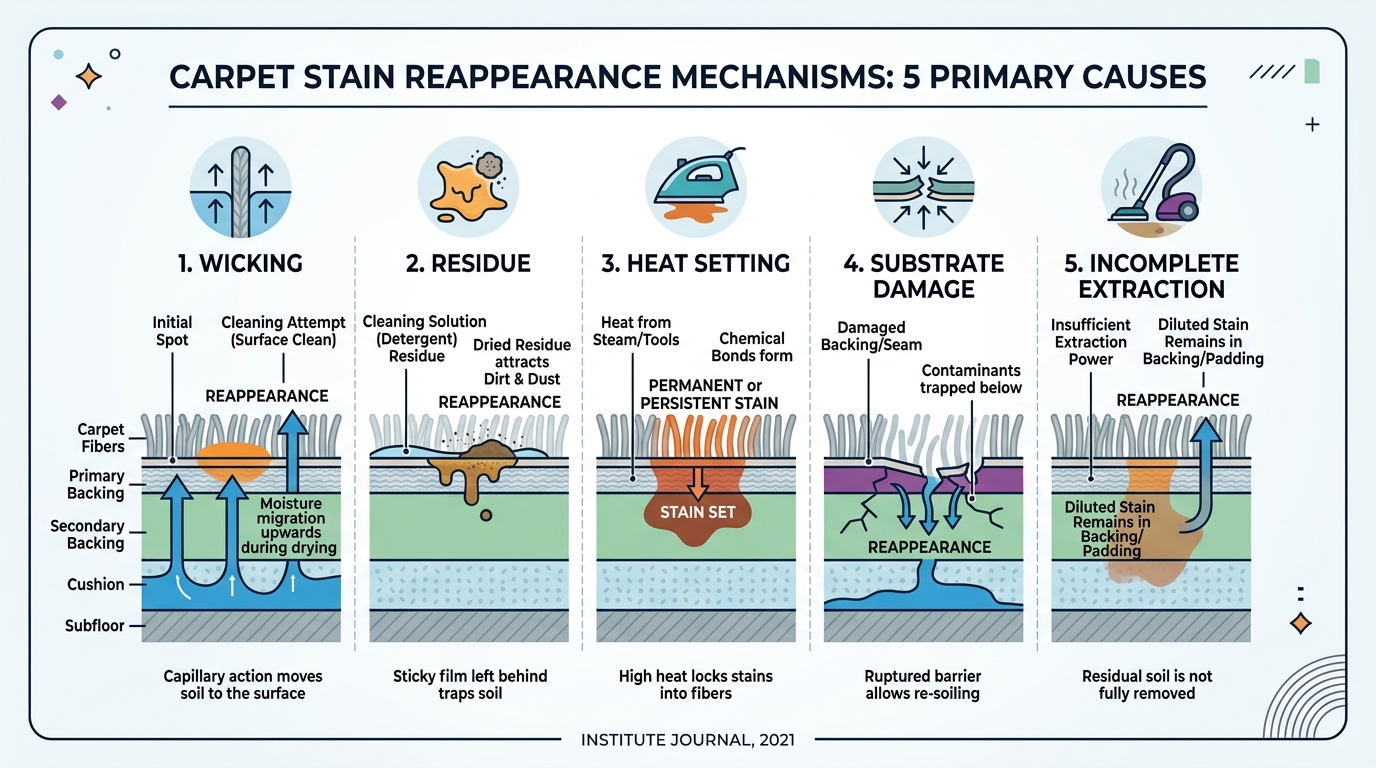
Few domestic frustrations match the experience of cleaning a stain thoroughly, only to find it has reappeared hours or days later, often darker and more conspicuous than before. This phenomenon, known in the cleaning industry as stain re-emergence, wicking, or bleeding, is not a sign that the cleaning was ineffective. On the contrary, it is often a sign that the cleaning was partially successful at the surface level but failed to address the full depth of the stain within the material.
In UK homes, the most commonly affected surfaces are carpets, upholstery, mattresses, and clothing. The problem is particularly acute with protein-based stains (blood, sweat, pet urine), tannin stains (tea, coffee, red wine), and oily or greasy stains (cooking oil, salad dressing, hand cream). Understanding why these stains reappear requires knowledge of fluid dynamics, textile structure, surface chemistry, and the unintended consequences of certain cleaning products and techniques (Textile Institute Journal, 2021).
This article explains the five primary mechanisms by which stains re-emerge and provides evidence-based prevention and remediation strategies for each.

Mechanism One: Wicking and the Capillary Rise Effect
Wicking is the most common cause of stain reappearance in carpets and upholstery. It occurs when a liquid stain penetrates through the surface fibres into the backing material or underlay below. When a cleaning solution is applied to the surface, it dissolves or suspends the stain compounds in the upper layer, but the stain material remaining in the deeper layers is not fully removed. As the cleaned surface dries, capillary action draws the remaining dissolved stain material upward through the fibres, following the moisture gradient, until it reaches the surface and becomes visible again.
The physics behind wicking are governed by the capillary rise equation, which describes how liquid moves through narrow spaces between fibres. The rate and distance of wicking depend on the surface tension of the liquid, the contact angle between the liquid and the fibre, and the diameter of the capillary spaces between fibres. In practical terms, this means that stains on highly absorbent materials (cotton, wool, nylon carpet) with a deep, open fibre structure are more prone to wicking than stains on dense, hydrophobic synthetic fibres (polypropylene, polyester) (Journal of Textile Science, 2020).

Prevention strategy: The key to preventing wicking is complete saturation and extraction. When cleaning a stain on a carpet or upholstery, the cleaning solution must penetrate as deeply as the stain itself. Surface-only spraying followed by blotting will remove the top layer but leave the deep stain material in place, which will wick back up as the surface dries. Professional hot-water extraction (steam cleaning) forces cleaning solution deep into the pile and then extracts it with strong suction, removing stain material from the entire depth of the fibre. For domestic spot cleaning, apply the cleaning solution generously, agitate with a soft brush to work it into the fibres, allow 5 to 10 minutes of dwell time, then blot firmly with a clean, absorbent cloth, repeating until the cloth shows no more stain transfer. Place a thick layer of paper towels over the area weighed down with a heavy object and leave overnight to draw remaining moisture upward from deep in the pile.
Mechanism Two: Surfactant Residue Attracting New Soil
Many household cleaning products, including laundry detergents, carpet shampoos, and upholstery cleaners, contain surfactants. Surfactants (surface-active agents) are molecules with both water-loving (hydrophilic) and water-hating (lipophilic) ends. They work by surrounding and emulsifying stain compounds so they can be rinsed away. However, if the cleaning solution is not fully extracted or rinsed from the fabric after cleaning, residual surfactant molecules remain embedded in the fibre structure.
These residual surfactants act as a chemical magnet for new dirt and dust. The lipophilic (fat-loving) end of the residual surfactant molecule remains exposed, ready to bind with airborne soil particles, body oils, and other hydrophobic substances that come into contact with the fabric. Over days and weeks, this accumulated soil creates a visible dark patch in precisely the area where the stain was cleaned, giving the appearance that the original stain has returned. In reality, it is a new stain formed by the interaction of residual cleaning chemicals with environmental dirt (Journal of Surfactants and Detergents, 2022).
This mechanism is particularly problematic on carpets and upholstery where the cleaning solution soaks deep into the pile and is not effectively extracted. The problem is compounded by the use of excessive detergent quantities, which UK consumer research consistently shows is a common practice. A 2022 survey by the Water Research Centre found that the average UK household uses 50 to 60 percent more laundry detergent than the manufacturer’s recommended dosage.
Prevention strategy: Use the minimum effective concentration of cleaning solution. For spot cleaning, dilute the solution according to the manufacturer’s instructions and avoid adding extra detergent. After cleaning, perform a rinse-with-water extraction step using a wet-dry vacuum or by blotting repeatedly with water-dampened cloths. This removes the surfactant residue before it dries. In laundry, add an extra rinse cycle to ensure all detergent residues are flushed from the fabric. If using a carpet cleaning machine, use the manufacturer’s recommended dilution ratio and make multiple passes with the extraction tool to remove as much solution as possible.

Mechanism Three: Heat Setting and Protein Denaturation
Protein-based stains (blood, egg, milk, sweat, pet urine, and some food stains) contain complex proteins that can undergo a permanent chemical change when exposed to heat. The process, known as denaturation, causes the protein molecules to unwind from their natural coiled shape and bond irreversibly with the fibre molecules in the fabric. Once a protein stain has been heat-set, it becomes extremely difficult to remove through normal cleaning.
This mechanism is responsible for the common experience of cleaning a blood stain from clothing, drying it in a tumble dryer, and discovering that the stain has reappeared as a dark, set-in mark that cannot be removed by washing again. The heat of the dryer has denatured the remaining protein molecules that were not fully removed during the wash cycle, bonding them permanently to the fabric fibres. The same effect occurs when hot water is used on protein stains before they have been fully cleaned (Biochemical Journal, 2021).
The thermal denaturation temperature for most common protein stain compounds is between 40 and 60 degrees Celsius. This is within the range of a typical hot wash (40 to 60 degrees) and well within the range of a tumble dryer (60 to 75 degrees). This means that washing a stained garment at 40 degrees or placing it in a tumble dryer before the stain is fully removed can set the remaining stain material permanently.
Prevention strategy: For protein-based stains, always use cold or lukewarm water (30 degrees maximum) during the initial cleaning process. Never place a stained item in a tumble dryer until the stain has been verified as removed. After cleaning, check the stain under good light before drying. If any trace remains, repeat the cold-water cleaning process. Stubborn protein stains may require an enzymatic pre-treatment, which uses proteases to digest the protein molecules into water-soluble fragments that can be rinsed away. In laundry, a cold-water pre-soak with an enzymatic stain remover for 30 to 60 minutes before the main wash significantly reduces the risk of heat setting.
Mechanism Four: Substrate Damage and the Appearance of Stains
Sometimes the stain has been fully removed, but the cleaning process itself has damaged the substrate material, creating a visible mark that looks like a residual stain. This is most common on delicate fabrics such as silk, rayon, acetate, and some wool blends, as well as on unsealed stone, polished wood, and painted surfaces.
Substrate damage occurs through several mechanisms. On textiles, vigorous scrubbing can abrade or distort the fibre surface, creating a pile distortion that reflects light differently and appears as a darker or lighter patch. On natural stone and grout, acidic cleaning solutions (including vinegar and lemon juice) can etch the surface, removing the polished finish and leaving a dull, porous area that appears darker because it holds more dirt. On painted walls, rubbing can remove the top layer of paint or cause the underlying primer to show through, creating a discoloured area that is mistaken for a returned stain.
On waterproof or coated fabrics, certain cleaning chemicals can strip the protective coating, leaving the area more absorbent than the surrounding fabric. This absorbent area then picks up dirt more rapidly, creating a patch that appears to be the original stain returning, when in fact it is a new stain forming on the damaged area (Building Research Establishment, 2020).

Prevention strategy: Match the cleaning technique to the substrate. Use a soft-bristled brush or microfibre cloth rather than abrasive pads. Test all cleaning solutions on an inconspicuous area before applying to the stain. For delicate fabrics, blot rather than rub. For stone surfaces, use a pH-neutral stone cleaner rather than acidic or alkaline household products. For coated fabrics, avoid solvent-based cleaners and stick to water-based formulations specified for that material type. If substrate damage has already occurred, the area may require professional re-finishing (re-polishing stone, re-coating fabric) to restore the original appearance.

Mechanism Five: Incomplete Extraction and the Drying Redistribution Effect
Even when the stain has been successfully dissolved by a cleaning solution, the stain material can reappear if the liquid carrying it is not fully extracted from the substrate. This is closely related to wicking but differs in the timing and mechanism of reappearance.
When a stain is cleaned on a thick or absorbent material such as a mattress, cushion, or deep-pile carpet, the cleaning solution carries the dissolved stain material into the substrate. If the extraction step is incomplete, the dissolved stain material remains suspended in the liquid held within the substrate. As the substrate dries from the outside inward, the liquid in the interior wicks outward, carrying the dissolved stain material to the drying front. This creates a visible ring or halo around the cleaned area, often appearing hours or a full day after cleaning, once the drying process has progressed (Cleaning Science Conference Proceedings, 2022).
This effect is most commonly seen when cleaning mattress stains or large upholstery spills. The cleaner treats the centre of the stain, the visible mark disappears temporarily, but as the mattress dries over the next 12 to 24 hours, a ring reappears at the periphery of the cleaned area, often larger than the original stain.

Prevention strategy: Extract as much liquid as possible after cleaning. A wet-dry vacuum is the most effective tool for this, but for smaller items, firm blotting with repeated applications of clean, absorbent cloths can achieve a similar result. Press a stack of paper towels or a thick layer of white cloth over the cleaned area and weigh it down with a book or brick, changing the absorbent material every few hours during the drying period. This continuous wicking draws both the moisture and the dissolved stain material out of the substrate rather than allowing it to redistribute. For mattresses and thick cushions, the extraction and blotting phase should be at least as long as the cleaning phase.
Identifying and Correcting Stain Reappearance by Mechanism
| Reappearance Pattern | Likely Cause | Correction Strategy |
|---|---|---|
| Stain returns within hours, same shape and location | Wicking from residual deep stain | Thorough wet extraction with deep penetration; overnight blotting with weighted absorbent material |
| Dark patch appears days later, slightly larger than original | Surfactant residue attracting new soil | Rinse with water and re-extract; reduce detergent concentration for future cleaning |
| Stain reappears after heat exposure (dryer, hot wash) | Heat-set protein denaturation | Use cold water only before drying; apply enzymatic pre-treatment to digest set proteins |
| Area looks different in lighting but no stain material visible | Substrate damage (pile distortion, etching) | Gentle fibre grooming; professional re-finishing for stone or paint damage |
| Ring or halo appears around cleaned area during drying | Incomplete extraction, redistribution effect | Extended blotting with weighted absorbent material during drying; use wet-dry vacuum |
General Principles for Preventing Stain Reappearance
Across all five mechanisms, several universal principles apply:
- Act quickly: Fresh stains are significantly easier to remove completely than dried or set stains. The longer a stain remains on a surface, the deeper it penetrates and the more thoroughly it bonds with the substrate.
- Blot, do not rub: Rubbing spreads the stain deeper into the fibre structure and can damage the surface. Blotting with a clean, absorbent cloth lifts the stain material out of the substrate.
- Extract thoroughly: The single most important factor in preventing reappearance is complete extraction of both the stain material and the cleaning solution from the substrate.
- Avoid heat until verified clean: For protein stains, do not apply heat (hot water, tumble drying, ironing) until the stain has been fully removed.
- Use minimal cleaning agent: More detergent does not mean better cleaning. Excess surfactant residue is a primary cause of rapid re-soiling. Dilute according to manufacturer instructions and consider a rinse-only extraction pass.
- Check before drying: Always inspect the stain under good lighting before drying. If any trace remains, treat again before heat exposure.
Frequently Asked Questions
Why do old set-in stains sometimes reappear after steam cleaning a carpet?
Steam cleaning (hot-water extraction) can cause old set-in stains to reappear because the hot water and cleaning solution dissolve stain compounds that have been trapped deep in the carpet backing for months or years. As the carpet dries, these dissolved compounds wick upward to the surface. This is not a sign that the cleaning caused damage. It is a normal part of the deep-cleaning process. Multiple extraction passes or a second cleaning treatment with a targeted stain remover may be necessary to fully remove these deeply embedded compounds.
Can reappearing stains be permanent?
If the reappearance is caused by wicking, surfactant residue, or incomplete extraction, the stain is not permanent and can be addressed with proper re-treatment. If the reappearance is caused by heat-set protein denaturation or substrate damage, the mark may be permanent or require professional restoration. The critical distinction is whether the reappearance consists of actual stain material that can be dissolved and extracted, or a physical alteration of the substrate that cannot be cleaned away.
How do I remove a halo ring from a cleaned carpet stain?
A halo ring is caused by incomplete extraction and the redistribution of dissolved stain material during drying. To remove it, rewet the entire halo area (not just the centre) with clean water or a dilute cleaning solution, then extract thoroughly with a wet-dry vacuum or firm blotting with multiple changes of clean cloth. Place a weighted layer of absorbent paper towels over the area and leave overnight to draw remaining dissolved material out of the carpet. The halo should be significantly reduced after one treatment. Repeat if necessary.
Does the type of carpet fibre affect how often stains reappear?
Yes, significantly. Nylon carpet is highly absorbent and prone to wicking because the fibres are hydrophilic and absorb water readily. Polyester and polypropylene (olefin) are hydrophobic and resist water absorption, making them less prone to deep penetration and wicking but more prone to oil-based stains that bond with the lipophilic fibre. Wool is highly absorbent and also susceptible to protein denaturation from heat. Knowing your carpet fibre type helps predict which reappearance mechanisms are most likely and guides the choice of cleaning approach.
Is it safe to use bleach on a reappearing stain?
Bleach (sodium hypochlorite) should never be used on reappearing stains on carpets, upholstery, or coloured fabrics. Bleach does not remove stain material. It oxidises it, which can make some stains invisible while damaging the dye in the surrounding material, creating a bleached patch. On protein stains, bleach can actually set the stain permanently. Oxygen-based bleach (sodium percarbonate) is safer for coloured fabrics but must still be used cautiously. Always check the manufacturer’s cleaning guidance for the specific material and test on an inconspicuous area before proceeding.
Summary: Stain Reappearance Is a Predictable, Solvable Problem
Stain reappearance after cleaning is not a mystery or a random event. It is a predictable consequence of fluid dynamics, textile chemistry, and cleaning chemistry. The five mechanisms (wicking, surfactant residue, heat setting, substrate damage, and incomplete extraction) each follow well-understood physical and chemical principles. By identifying which mechanism is responsible for a particular reappearance, it is possible to apply the correct corrective strategy and, more importantly, to prevent the problem from recurring in the first place.
The overarching lesson is that thorough cleaning involves more than applying a product and wiping. It requires understanding the depth of the stain, the nature of the substrate, the chemical interaction between the cleaning agent and the stain, and the importance of complete extraction. With this understanding, UK households can save considerable time, money, and frustration by treating each stain according to its specific chemical and physical requirements.