
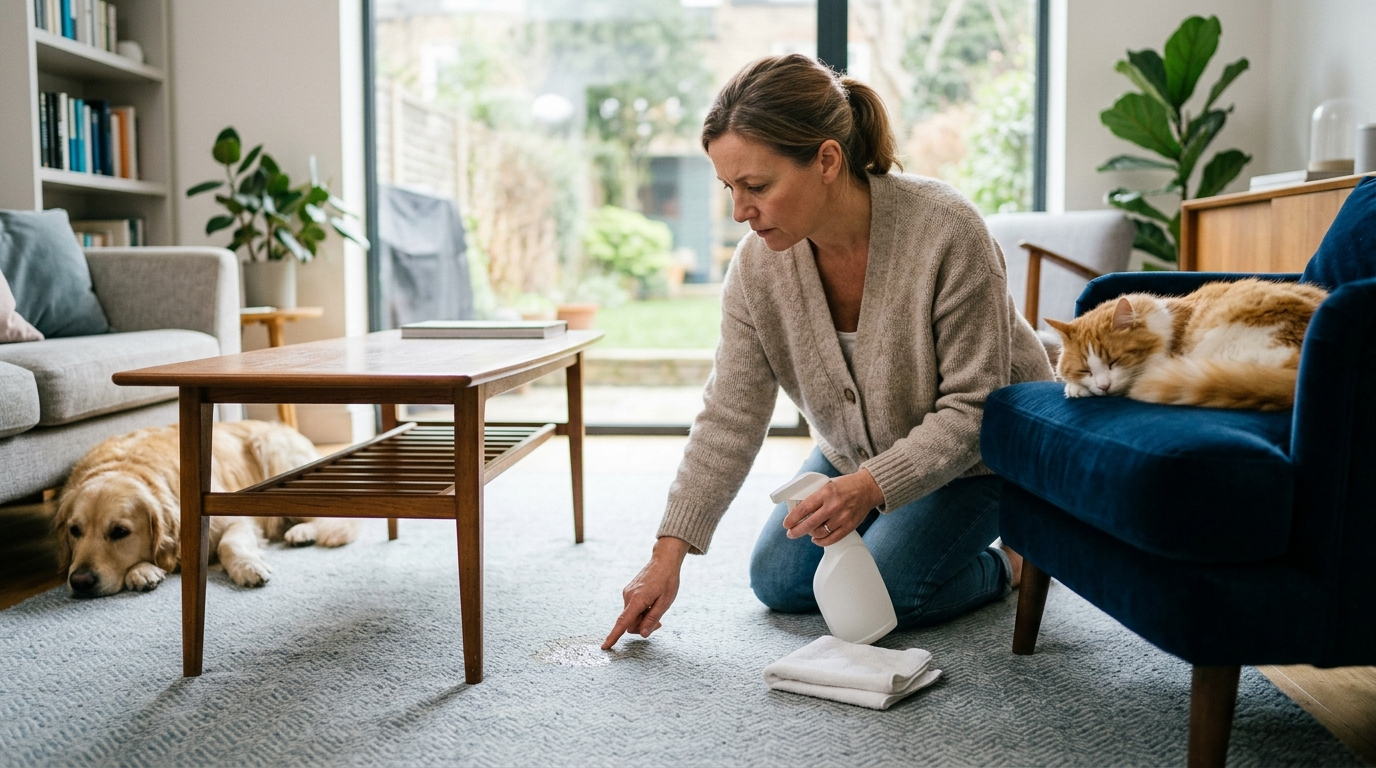
Every pet owner knows the frustration: you clean a urine accident thoroughly, the area appears clean and smells fresh, but days or weeks later the odour returns. It might happen on a humid day, after vacuuming, or when the central heating kicks in. The smell reappears as strongly as if the accident had just happened, despite your best cleaning efforts.
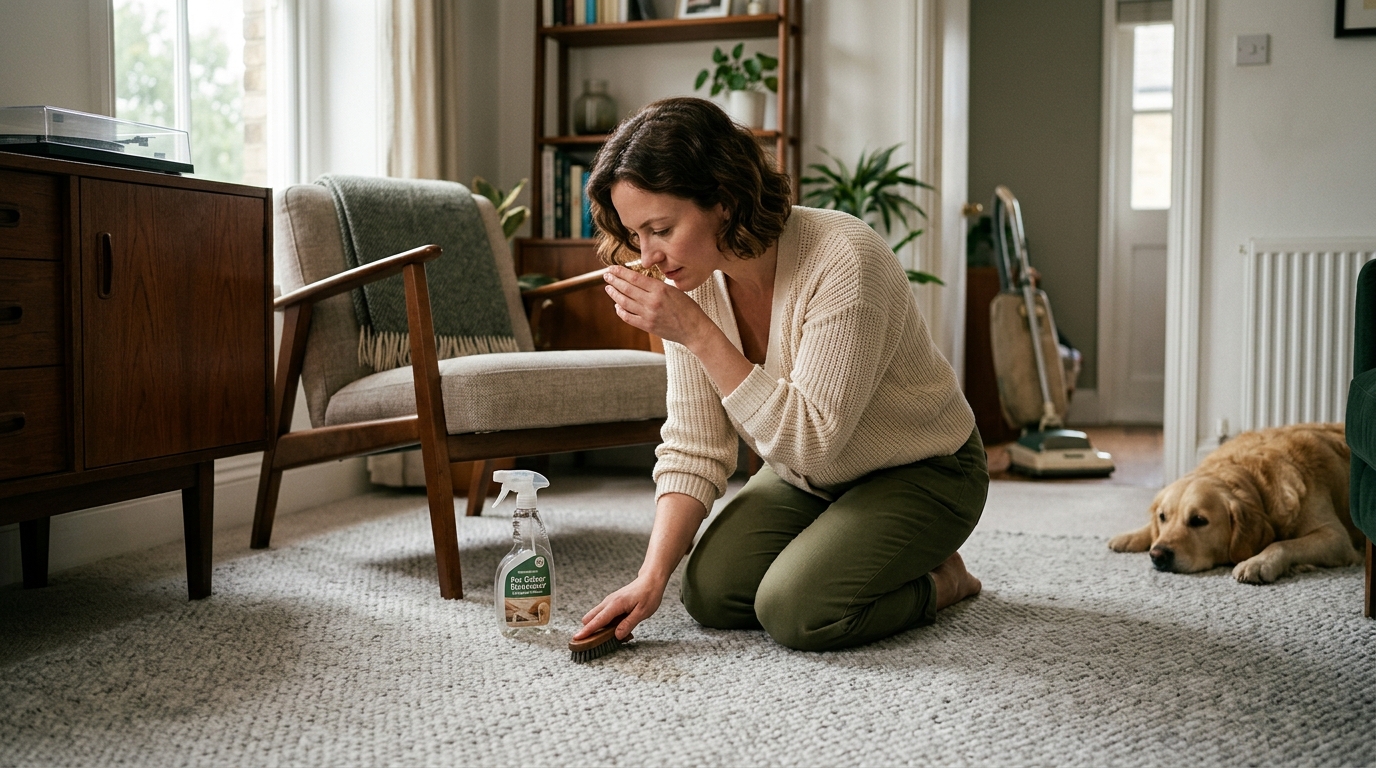
This is not a failure of effort or hygiene. It is a predictable chemical process rooted in the molecular composition of urine and the porous structure of household materials. Understanding the science behind this phenomenon is the first step toward achieving genuinely permanent odour removal.
The Chemistry of Urine: More Than Just Water
Fresh urine is approximately 95 per cent water, with the remaining 5 per cent containing a complex mixture of compounds including urea, uric acid, creatinine, urobilinogen, electrolytes, hormones, and pheromones. When urine is deposited on a porous surface such as carpet, upholstery, or unsealed wood, the water component begins to evaporate, but the dissolved solids remain. It is the behaviour of these solid compounds, particularly uric acid, that determines whether the odour returns.
Urea is a water-soluble nitrogenous compound that bacterial enzymes rapidly convert into ammonia and carbon dioxide through a process called hydrolysis. Ammonia produces the sharp, acrid smell characteristic of fresh urine. Standard household cleaners can remove urea relatively easily through dilution and rinsing.
Uric acid is the critical compound. Unlike urea, uric acid is only sparingly soluble in water. As the liquid component of urine evaporates, uric acid precipitates out of solution and forms microscopic crystalline structures. These crystals are chemically stable, odourless when dry, and resist dissolution by water, detergents, vinegar, and most conventional cleaning agents .
Pheromones and hormones present in urine serve a biological signalling function. These compounds are designed to persist in the environment, which is why they remain detectable to animals long after cleaning. From a chemical standpoint, this persistence makes them particularly challenging to remove without targeted enzymatic degradation.
Why the Smell Returns: The Uric Acid Reactivation Cycle
The recurring nature of pet urine odour is explained by the interaction between uric acid crystals and environmental moisture. This cycle operates as follows:
1. Urine penetrates porous materials. When a pet urinates on carpet, the liquid does not stop at the surface fibres. It soaks through the carpet pile, through the backing, into the underlay (padding), and in severe cases, into the subfloor below. Surface cleaning only treats the top layer of fibres, leaving the vast majority of contamination untouched in the deeper layers .
2. Uric acid crystallises as the liquid dries. As the water content evaporates over 24 to 72 hours, uric acid forms sharp, needle-like crystals that bond to carpet fibres, backing material, and underlay. These crystals are odourless when dry, which is why the area can appear completely clean and smell-free immediately after cleaning.
3. Moisture triggers reactivation. Uric acid crystals are hygroscopic: they actively absorb moisture from the surrounding environment. When relative humidity rises above approximately 70 per cent, or when the carpet is re-wetted by cleaning, spills, or even the moisture from vacuuming, the crystals absorb water and dissolve back into solution. This releases the trapped volatile compounds, including ammonia and mercaptans, producing the characteristic stale urine odour .
4. The cycle repeats indefinitely. Each time the crystals dry out again, they re-form. This reactivation cycle can continue for years. Carpet cleaning professionals report finding active uric acid salt deposits in carpet underlay up to 20 years after the original accident occurred. So long as the crystals remain physically present, they will reactivate every time moisture conditions permit.
The Iceberg Problem: Why Surface Cleaning Is Insufficient
The distribution of urine contamination in a carpet or upholstery assembly follows what cleaning professionals call the iceberg model. The visible stain on the surface fibres represents only a small fraction of the total contamination. Research using dye-tracing techniques has demonstrated that the contamination spreads laterally and deepens as it penetrates through successive layers:
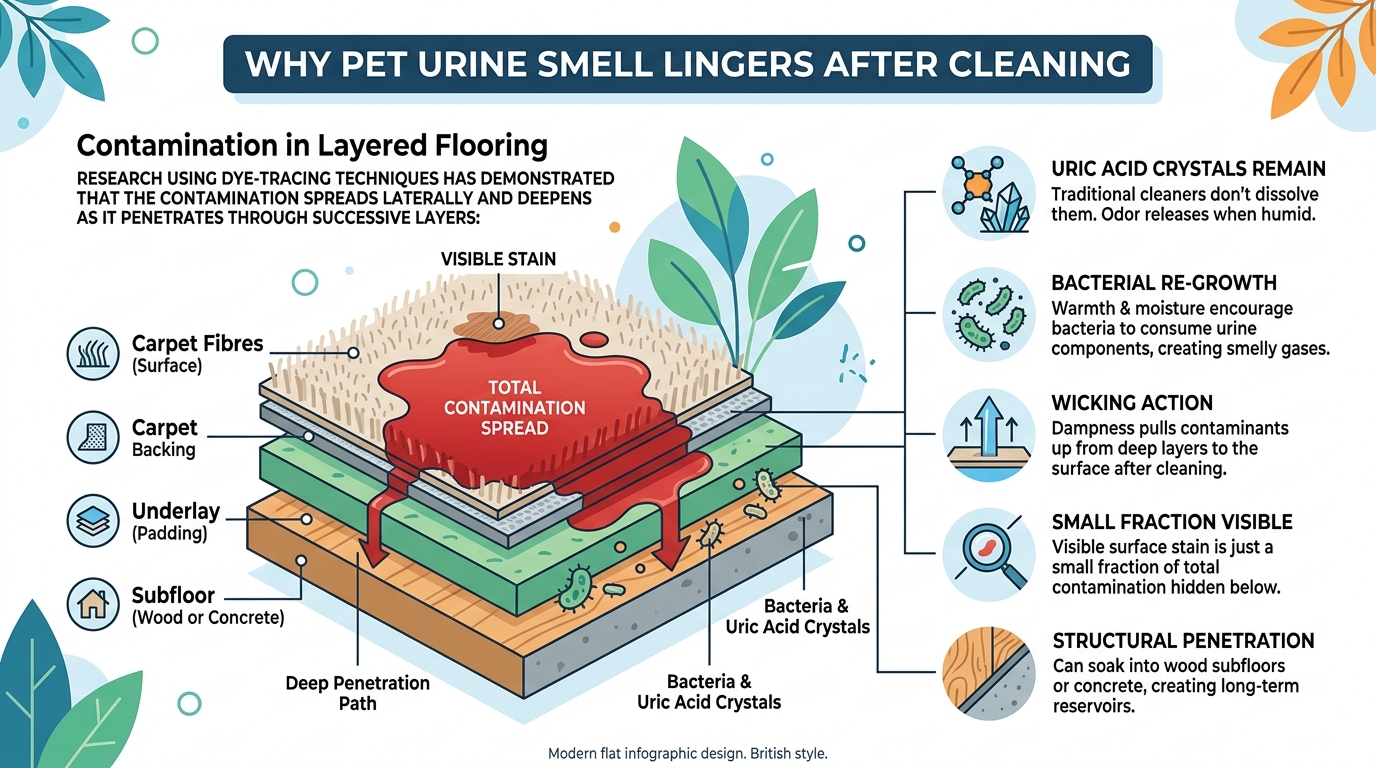
- Carpet fibres (surface): The visible point of contact. Most household cleaning methods address only this layer. Estimated at 10-20 per cent of total contamination volume.
- Carpet backing: A dense woven layer that traps urine solids as the liquid evaporates upward through the fibres. Crystallisation concentrates here.
- Underlay (padding): The most absorbent layer. Polyurethane foam underlay can hold many times its own weight in liquid. Urine spreads laterally in this layer, creating a contamination zone significantly wider than the surface stain.
- Subfloor: In repeated or long-untreated accidents, urine reaches the floor substrate. On wooden subfloors, the liquid penetrates between boards and into the wood grain, where crystallisation becomes effectively permanent without physical replacement or sealing.
Standard carpet cleaning methods, including shampooing, encapsulation, and even basic hot-water extraction (steam cleaning), primarily address the surface fibre layer. The extraction wand used in most professional and hire machines pulls moisture primarily from the carpet pile, not the underlay. This means that a full professional clean can leave the majority of uric acid crystals undisturbed in the deeper layers, ready to reactivate when conditions change.
Common Cleaning Mistakes That Make the Problem Worse
Using steam cleaners or hot water extraction: This is perhaps the most common and damaging error. The heat from steam or hot water (above 50 degrees Celsius) can bond uric acid proteins permanently to carpet fibres. Once heat-set, these bonds are extremely difficult to break, even with subsequent enzymatic treatment. Some professional cleaners refer to this as “cooking” the stain .
Using vinegar or bicarbonate of soda: These internet-recommended remedies are chemically incapable of dissolving uric acid crystals. Vinegar (acetic acid) can temporarily neutralise alkaline ammonia compounds, producing a short-term reduction in smell. Bicarbonate of soda absorbs some surface moisture and odour. Neither affects the uric acid crystals themselves, so the odour returns as soon as humidity rises.
Using ammonia-based cleaners: Ammonia is chemically similar to the compounds found in urine. Using an ammonia-based cleaner on a urine stain can actually attract pets back to the same spot to re-mark, as the ammonia smell resembles territorial marking signals from other animals.
Scrubbing vigorously: Aggressive scrubbing pushes urine deeper into the carpet pile and backing, widening the contamination zone. It also damages carpet fibres, making them more absorbent and more difficult to clean in future. Blotting is always preferable to scrubbing.
Using fragranced products to mask the odour: Air fresheners, carpet powders, and fragranced cleaning sprays do not remove uric acid crystals. They simply layer a perfume on top of the odour source. Once the fragrance dissipates, the underlying odour remains unchanged. Additionally, the mixture of synthetic fragrance with urine compounds can produce a hybrid smell that some owners find more unpleasant than the original odour.
The Only Permanent Solution: Enzymatic Breakdown
Enzymatic cleaners are the only category of product that can permanently eliminate uric acid crystals and the organic compounds that cause recurring pet urine odour. They work through a fundamentally different mechanism to conventional cleaners:
Biological catalysis: Enzymatic cleaners contain specialised bacterial spores that lie dormant until they encounter organic matter. When activated by contact with urine, the bacteria produce specific enzymes including protease, lipase, amylase, and critically, uricase. These enzymes act as biological catalysts, accelerating the chemical breakdown of uric acid, urea, proteins, and fats into carbon dioxide, water, and simple inorganic molecules .
Penetration and dwell time: For enzymatic treatment to be effective, the solution must physically reach the uric acid crystals in the carpet underlay. This requires pouring (not spraying) a sufficient volume of solution to saturate through every layer the urine penetrated. The enzymes require sustained contact time typically 12 to 24 hours to complete the digestive process. Covering the treated area with a damp towel keeps the enzymes active and prevents premature drying .
Permanent elimination: Unlike surface cleaning, fragrance masking, or adsorption methods, enzymatic treatment converts odour-causing compounds into inert byproducts. Once the uric acid structure has been broken down at the molecular level, there are no remaining crystals to reactivate. The treatment is permanent, not temporary.
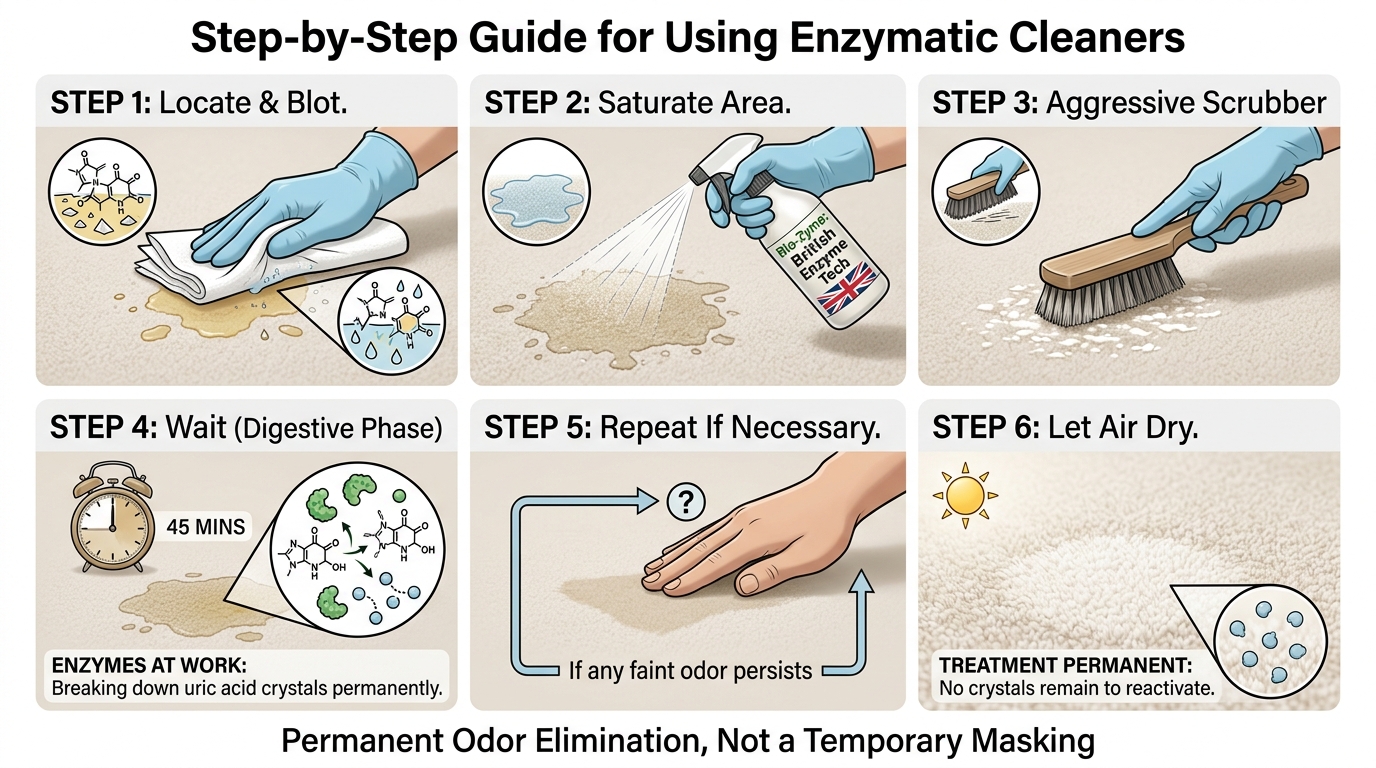
Enzymatic cleaners are not instantaneous. The digestive process takes time, and in some cases, the odour may temporarily intensify during the first 24 to 48 hours as the enzymes break down large organic molecules and release volatile byproducts. This is a normal part of the process and indicates that the treatment is working.
When Replacement Is the Only Option
In cases of severe, repeated contamination where urine has penetrated deeply into carpet underlay or wooden subfloors, enzymatic treatment may not be sufficient. The following situations typically require physical replacement:
- Saturated underlay: If the carpet padding has been repeatedly saturated over a wide area, it may be more cost-effective to replace it than to attempt enzymatic treatment. The underlay is the most absorbent layer and the most difficult to treat completely.
- Subfloor contamination: If urine has soaked through to a wooden subfloor, the uric acid crystals can become embedded in the wood grain. Sealing the subfloor with a shellac-based primer after cleaning may contain the odour, but replacing the affected section of flooring is sometimes the only reliable solution.
- Multiple years of untreated accidents: The longer uric acid crystals have been present, the more deeply they become embedded and the more extensive the contamination zone. In some cases, professional assessment is needed to determine whether treatment or replacement is the more practical option.
Frequently Asked Questions
Why does pet urine smell worse on humid days?
Uric acid crystals are hygroscopic, meaning they actively absorb moisture from the air. When relative humidity rises above approximately 70 per cent, the crystals absorb enough water to dissolve partially, releasing trapped volatile compounds including ammonia and sulphur-based mercaptans. This is why the odour is often most noticeable during wet weather, autumn, and winter months when indoor humidity is highest.
Can pet urine odour be permanently removed?
Yes, but only through enzymatic treatment that physically breaks down the uric acid crystals at a molecular level. The enzymes convert the crystals into carbon dioxide and water, which evaporate harmlessly. Once the crystals have been fully digested, there is nothing left to reactivate. Surface cleaning, vinegar, baking soda, and fragranced products cannot achieve this because they do not affect the crystalline uric acid structure.
Does steam cleaning make pet urine smell worse?
Steam cleaning and hot-water extraction can make the smell significantly worse in two ways. First, the heat and moisture reactivate dormant uric acid crystals in the underlay, releasing a fresh wave of ammonia and mercaptan compounds. Second, the heat can permanently bond urine proteins to carpet fibres, creating a stain and odour that is extremely difficult to remove even with subsequent enzymatic treatment.
How long does it take for enzymatic cleaners to work on set-in urine?
For set-in urine that has penetrated carpet underlay, enzymatic treatment typically requires 12 to 24 hours of sustained damp contact. The area must be kept moist throughout this period, as enzymes cease to function once dry. After the dwell period, the area should be allowed to air dry completely, which may take an additional 24 to 48 hours. Patience is essential: rushing the process with fans or heat will denature the enzymes and halt the digestive reaction.
Is it possible for pet urine odour to be permanent?
Without enzymatic treatment, the uric acid crystals remain in the carpet underlay indefinitely. They are chemically stable and will not degrade on their own over time. Professional carpet cleaners have reported reactivating 20-year-old uric acid deposits after re-wetting. The odour is effectively permanent so long as the crystals remain physically present. The only way to eliminate it permanently is to break down the crystals through enzymatic digestion or remove the contaminated material physically.
Summary: Understanding the Science for Lasting Results
Pet urine odour lingers after cleaning because the chemical compounds responsible, particularly uric acid crystals, are not removed by standard cleaning methods. These crystals form as urine dries, bond to porous materials, and reactivate every time they encounter moisture. The smell is not a sign of inadequate cleaning but of incomplete chemistry.
Permanent odour removal requires breaking the reactivation cycle at its source. Enzymatic cleaners that contain uricase and other targeted enzymes are the only household products capable of dismantling uric acid crystals at the molecular level. For severe contamination, professional assessment and in some cases material replacement may be necessary.
Understanding this chemistry transforms a frustrating, recurring problem into a solvable one. The smell returns not because you cleaned poorly, but because the cleaning chemistry you used was not equipped to address the nature of the contamination. Armed with the right knowledge and the appropriate enzymatic treatment, permanent pet urine odour removal is achievable.